Unmaking
This series examines how individual presence can be reduced through persistent structural, psychological and social constraint as it becomes visible in pictorial space. The works construct transformation as a spatial and structural process rather than a narrative one. What becomes visible is not collapse as an isolated event, but a progressive shift from autonomy toward functional existence and eventual fragmentation.
Each painting operates with a restrained visual vocabulary. A condensed blue form marks the individual presence. Black linear elements establish organizing frameworks that regulate position, movement, and visual dominance. These structures do not remain external. They penetrate the figure, segment its space and reorganize its internal hierarchy. Order functions as an active pictorial force that both stabilizes the composition and restricts internal movement.
Spatial fields narrow and directional movement is progressively restricted. Open relations give way to enclosure and interruption. Linear interventions redirect visual flow and limit expansion. The blue form loses continuity and spatial authority as the series advances. Identity remains present but no longer determines the pictorial structure.
Material decisions reinforce this construction. Thickened passages, revisions, and layered surfaces keep negotiation and resistance visible within the work. Density is not concealed but embedded in the image logic. Emotional states are not represented symbolically or narratively. They are produced through spatial tension, material weight, and controlled reduction.
The sequence follows five stages: Free, Held, Functional, Fading, Fragmented.
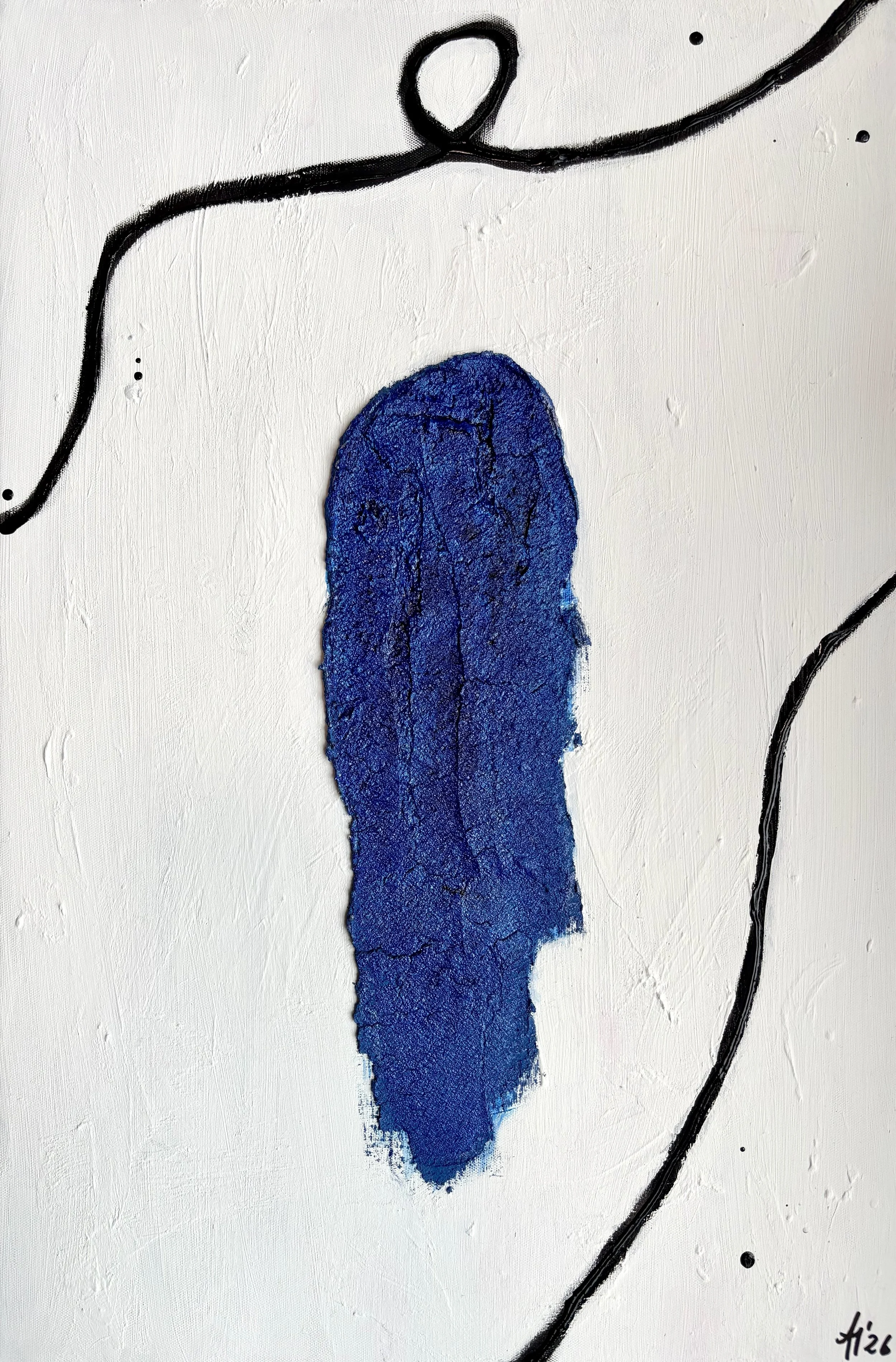
“Unmaking I - Free”, 40×60 cm, mixed media.
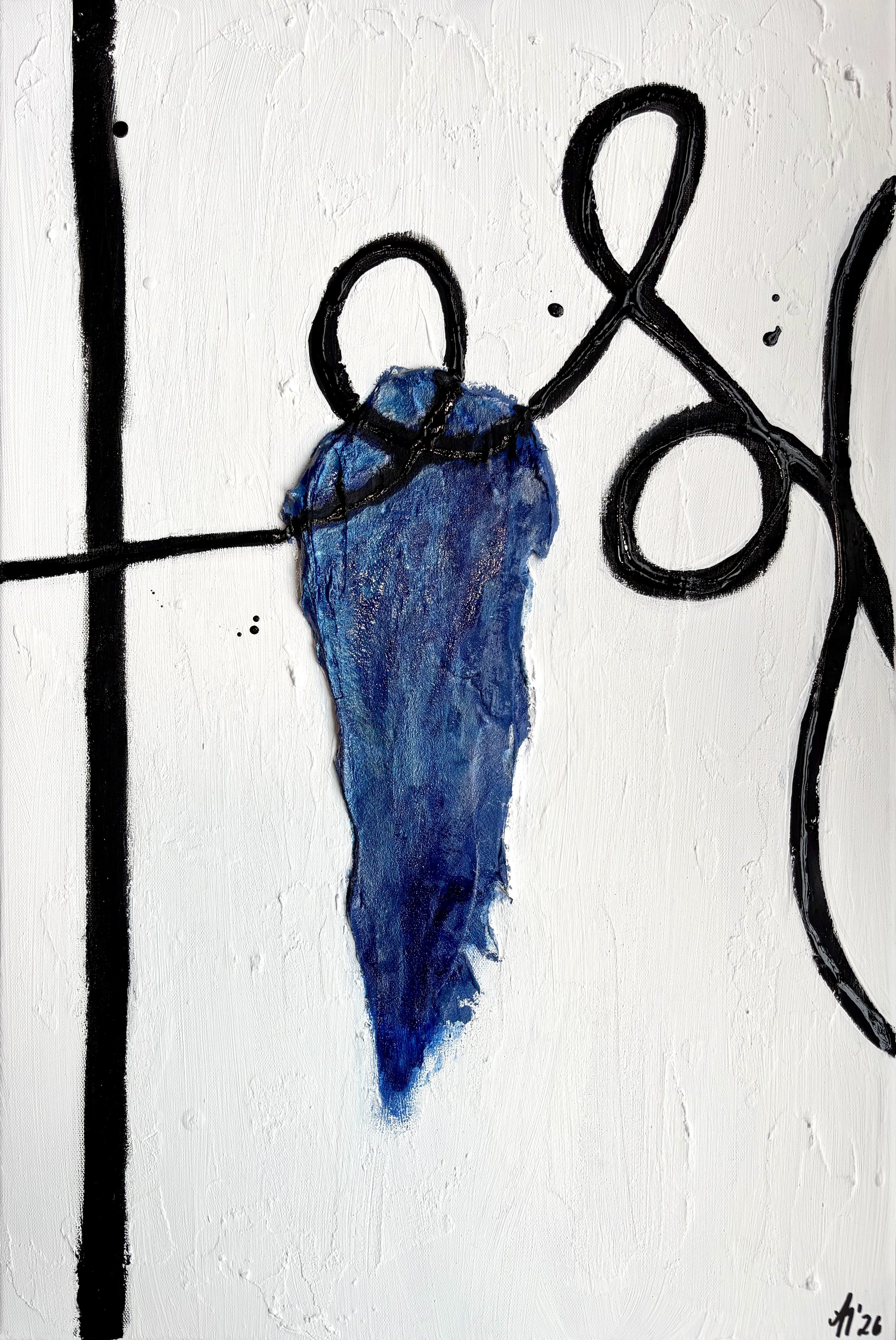
“Unmaking II - Held", 40×60 cm, mixed media.
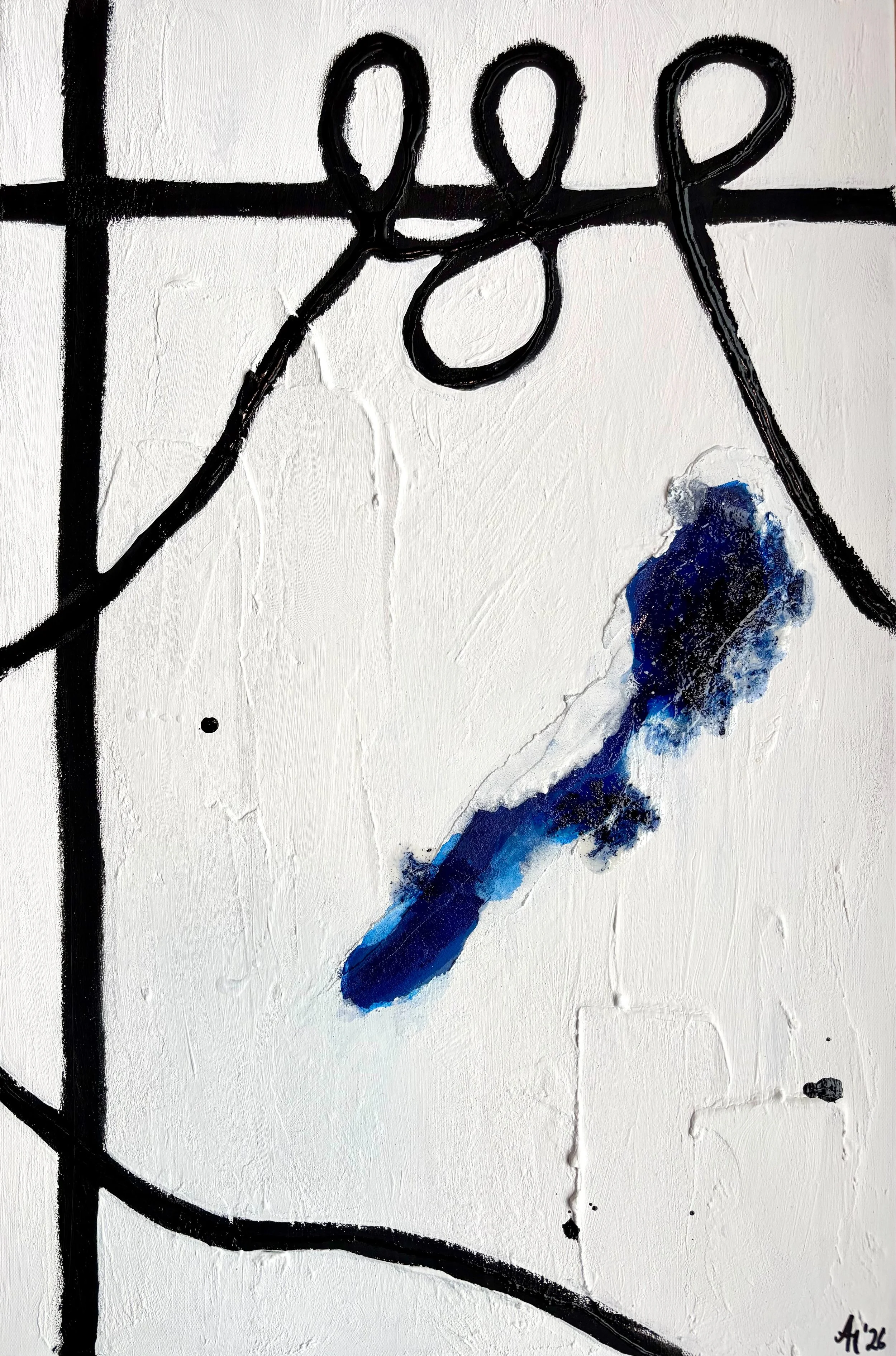
“Unmaking III - Functional", 40×60 cm, mixed media.
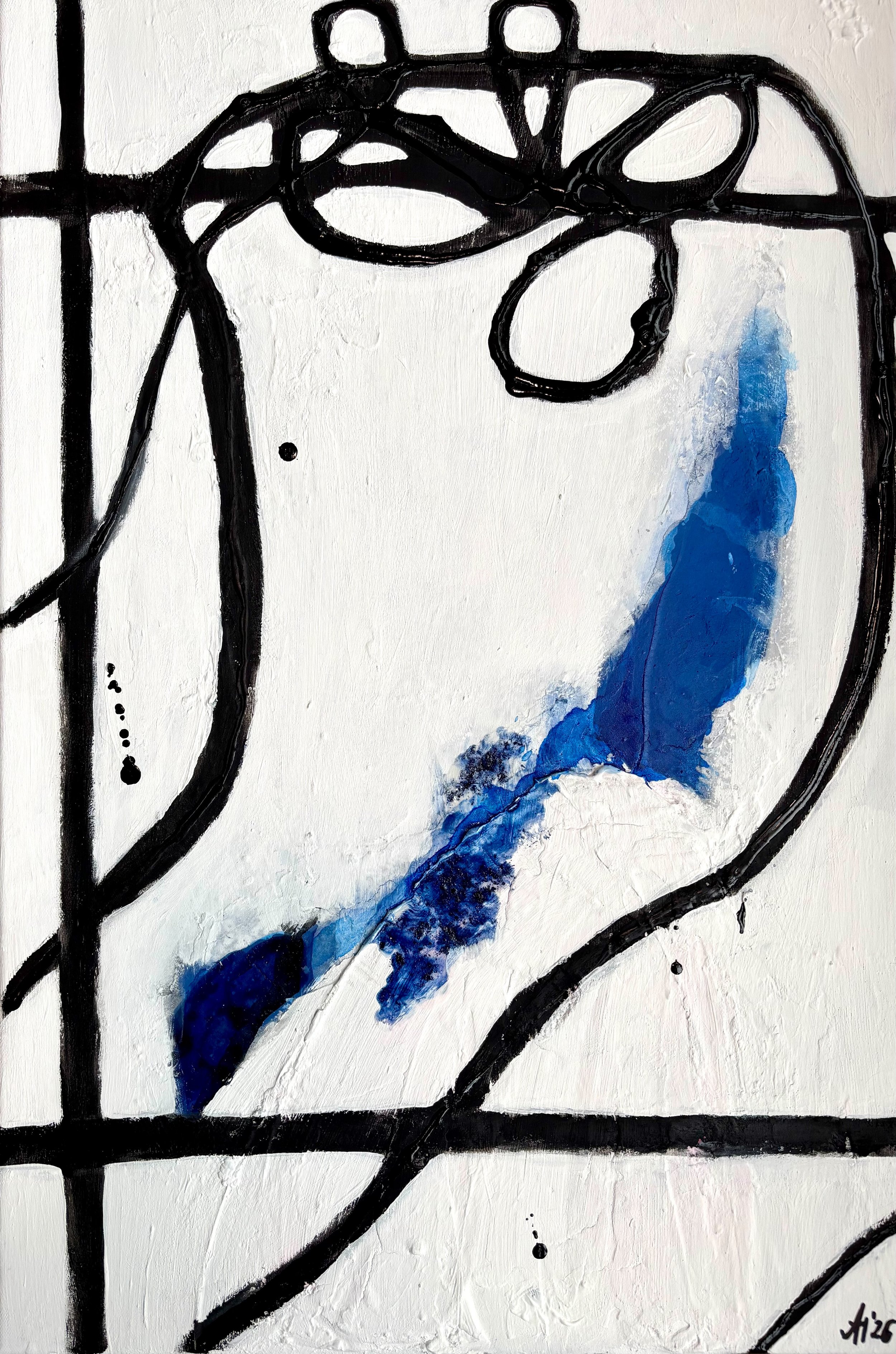
“Unmaking IV - Fading", 40×60 cm, mixed media.
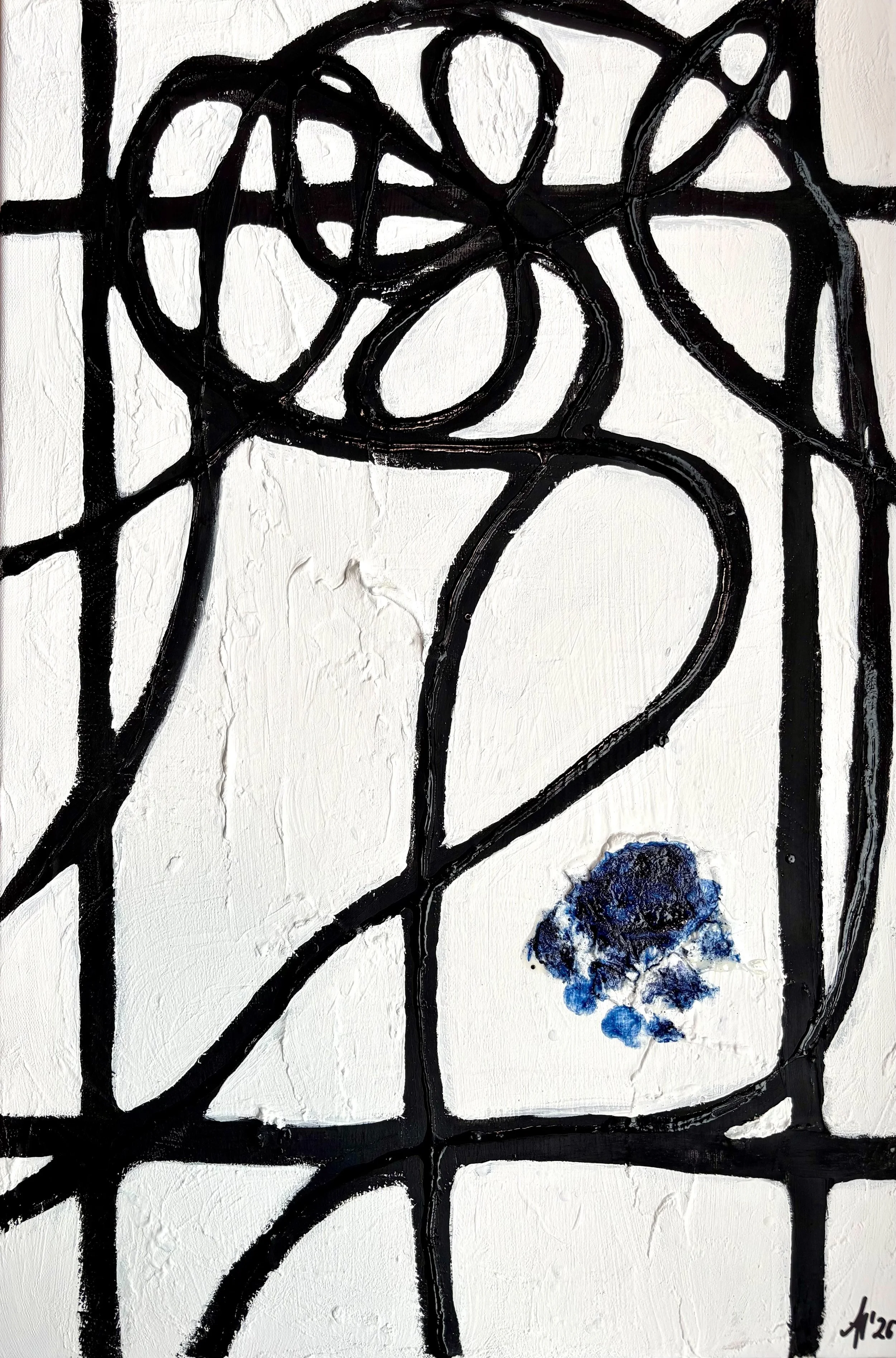
“Unmaking V - Fragmented", 40×60 cm, mixed media.
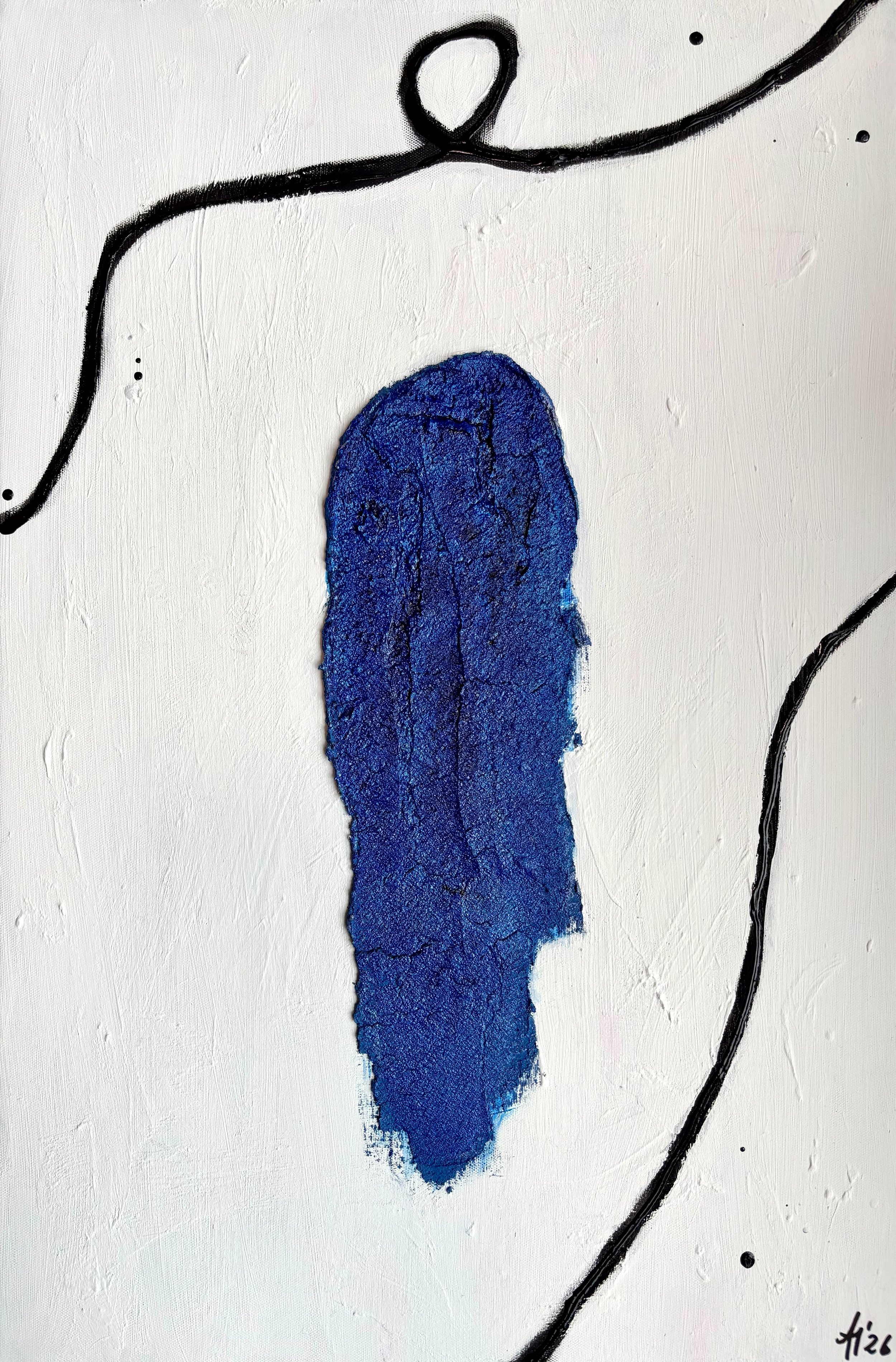
Unmaking I - Free
The painting establishes the initial condition of the series: a state in which the individual presence appears stable, self-contained, and spatially centered. The blue form occupies the pictorial field with a quiet sense of equilibrium. Its surface, built through structural paste and layered glazes, produces a subtly luminous and cohesive skin. Despite the material density of the form, its visual presence remains calm and internally unified.
The surrounding white field functions as an open spatial condition. It does not operate as emptiness but as a zone of potential movement and expansion in which the figure can exist without immediate restriction. Within this field, the individual retains spatial authority and perceptual clarity.
The black lines introduce the first indication of external structure. They frame the pictorial space and suggest systems capable of organizing orientation and movement. Yet at this stage they remain peripheral. They establish a framework without imposing direct constraint. The figure remains unaffected by their directional force and continues to hold the compositional center.
Material, color, and spatial openness therefore align to articulate a moment of relative autonomy. The work marks the point before structural pressure begins to penetrate the figure and reorganize its internal hierarchy.
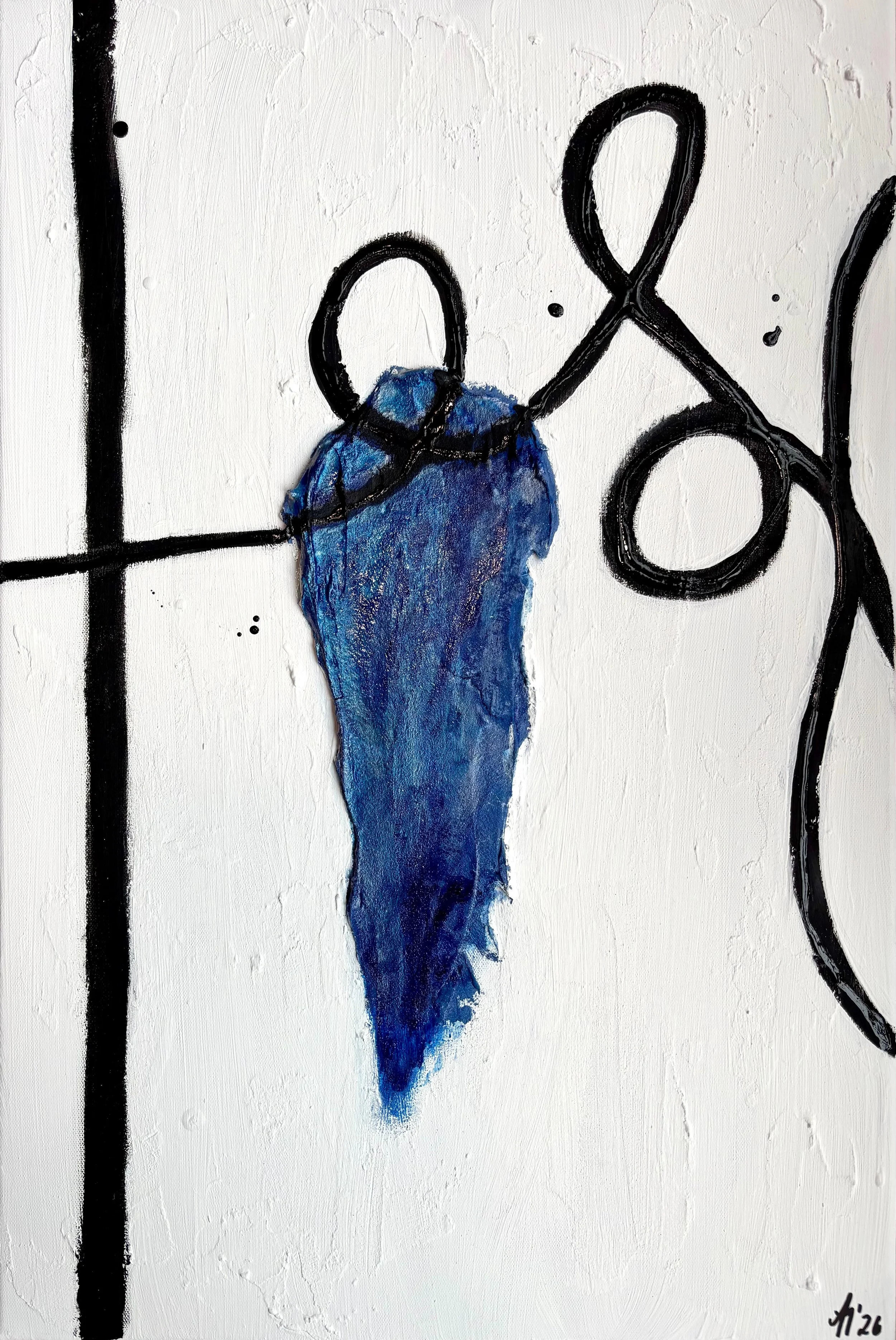
Unmaking II - Held
The second painting marks the moment at which external structure begins to cross the boundary of the figure. What previously functioned as a peripheral framework now enters the pictorial body itself. A black linear element intersects the blue form, transforming the line from a distant organizing device into an active structural force within the composition.
This intervention alters the condition of the figure. The blue form no longer appears entirely cohesive. Its surface becomes more fragile and uneven, revealing the accumulation of layered glazes and painterly revisions. Although the form remains materially elevated through structural paste, its skin appears thinner and more vulnerable, as if the integrity of the surface were beginning to erode.
The contact between line and form establishes a new structural relationship within the image. The line does not simply surround the figure but begins to inscribe itself into its spatial and visual territory. What previously operated as an external framework now initiates the first intrusion of structural pressure into the condition of the individual.
Despite this intervention, the figure still retains a degree of compositional authority. The blue form remains central and perceptually dominant, yet its equilibrium has been disturbed. The work therefore captures a transitional state in which autonomy persists but is no longer fully secure.
Unmaking III - Functional
The third painting marks a decisive structural shift within the series. The blue figure no longer maintains the stable, cohesive presence established in the earlier works. Its form appears fractured and unstable, as if its internal structure had begun to reorganize under sustained external pressure.
The surface of the figure reflects this transformation. The once consolidated body now appears disrupted and partially dispersed. Layers of paint separate and dissolve into the surrounding field, producing a form that is no longer visually contained within a single coherent mass. Portions of the figure retreat into the white space, while others remain suspended within the pictorial field.
At this stage the black lines no longer penetrate the figure directly. Instead, they begin to construct an increasingly dense structural environment around it. The surrounding framework becomes more dominant, gradually redefining the spatial conditions within which the figure exists.
The blue form therefore enters a state of functional adjustment. Its presence persists, yet it no longer determines the spatial logic of the composition. Rather than resisting the structural order that surrounds it, the figure appears to accommodate itself to it. Stability gives way to adaptation, marking the moment in which individual presence begins to transform into functional existence within the system.
Unmaking IV - Fading
The fourth painting marks the stage at which the figure begins to lose its material and spatial authority within the composition. The blue form no longer appears elevated or structurally cohesive. Its surface has flattened and expanded, spreading across the pictorial field in a thinner and more unstable configuration.
Material density gives way to dispersion. Certain passages of the form appear diluted and partially withdrawn into the surrounding white ground, while other areas condense into darker fragments of pigment. The once unified body of the figure now appears stretched and internally discontinuous, as if its structural integrity had begun to dissolve.
At the same time the surrounding linear structures multiply and intensify. The black lines increasingly define the spatial architecture of the painting, occupying larger portions of the pictorial field and redirecting the movement of the eye. Rather than functioning as isolated elements, they begin to operate collectively as a system that organizes and restricts the available space.
Within this environment the figure loses its previous compositional authority. Its presence persists, yet it no longer governs the spatial logic of the image. The blue form appears suspended within a field increasingly controlled by external order, marking the stage at which individual presence begins to fade within the structural framework that surrounds it.
Unmaking V - Fragmented
The final painting marks the point at which the structural system fully dominates the pictorial field. The black linear structures now occupy almost the entire spatial environment of the image, transforming the composition into a dense structural framework that determines orientation, movement, and visual hierarchy.
Within this structure the blue figure no longer appears as a cohesive body. The individual presence has contracted into a small cluster of pigment fragments. What once functioned as an extended and materially elevated form is now reduced to a condensed residue of color, dispersed and irregular.
The figure’s spatial authority has disappeared. Surrounded on all sides by the expanding linear system, the remaining fragments occupy only a marginal portion of the pictorial field. The white ground, which earlier allowed the figure to expand and move, now appears tightly regulated by the surrounding structure.
At this stage the individual no longer operates as a determining force within the image. Its presence persists only as a reduced core of pigment, while the structural framework governs the spatial and visual order of the composition. The work therefore concludes the sequence by rendering the final state of compression: a condition in which individual presence has been fragmented and nearly absorbed by the system that surrounds it.