Unmaking - On Losing And Holding On To The Self
This series began with a single painting.
At that time, I was not thinking about a series or a defined concept. I was simply working intuitively and trying to understand something in a visual way. I wanted to see what happens when structures begin to shape an individual. How much pressure a form can hold before it starts to change.
The first image already contained everything that would later define the series. A white field as an open space, a blue form that carried a sense of presence, and black lines that began to move across the surface. I did not assign meaning to these elements right away, but I could feel that something in their relationship was not stable.
Looking at that first painting, I started asking myself what state this figure was in. It did not feel entirely free, but it was not fully constrained either. That question stayed with me and led me to develop the series further.
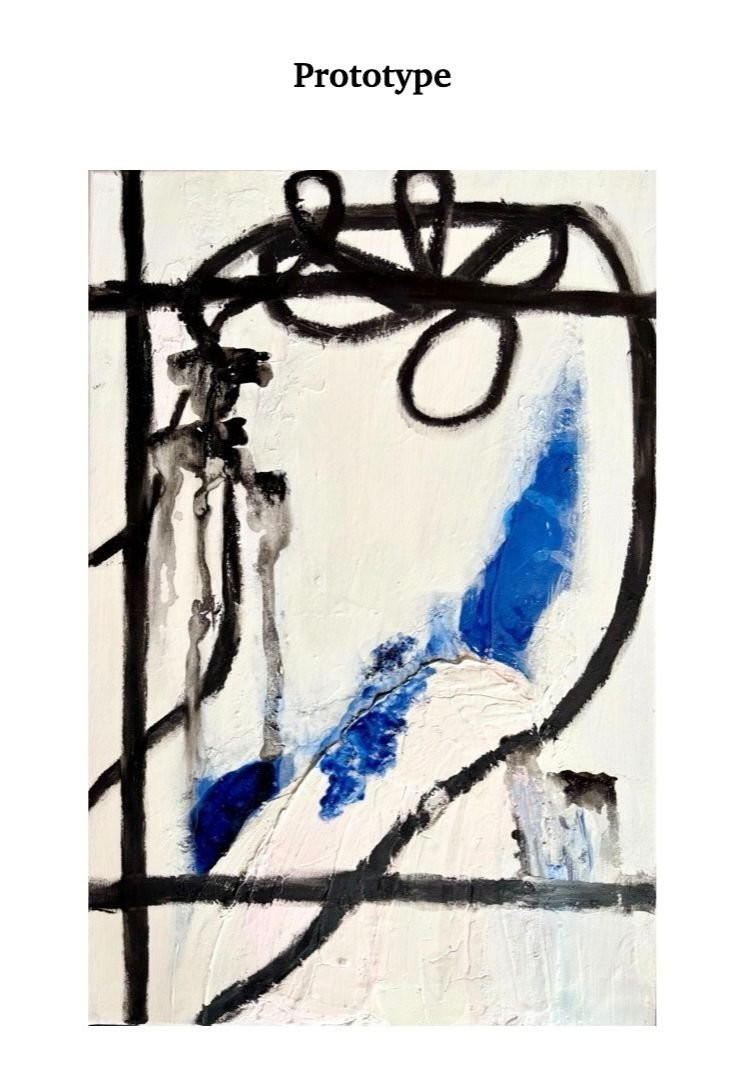
Prototype, later developed into Unmaking IV – Fading
From there, I began to think in stages. Not as a narrative, but as a gradual shift. I asked myself what comes before this moment and what follows after it. Through a series of sketches, I tried to understand how this change could unfold visually.
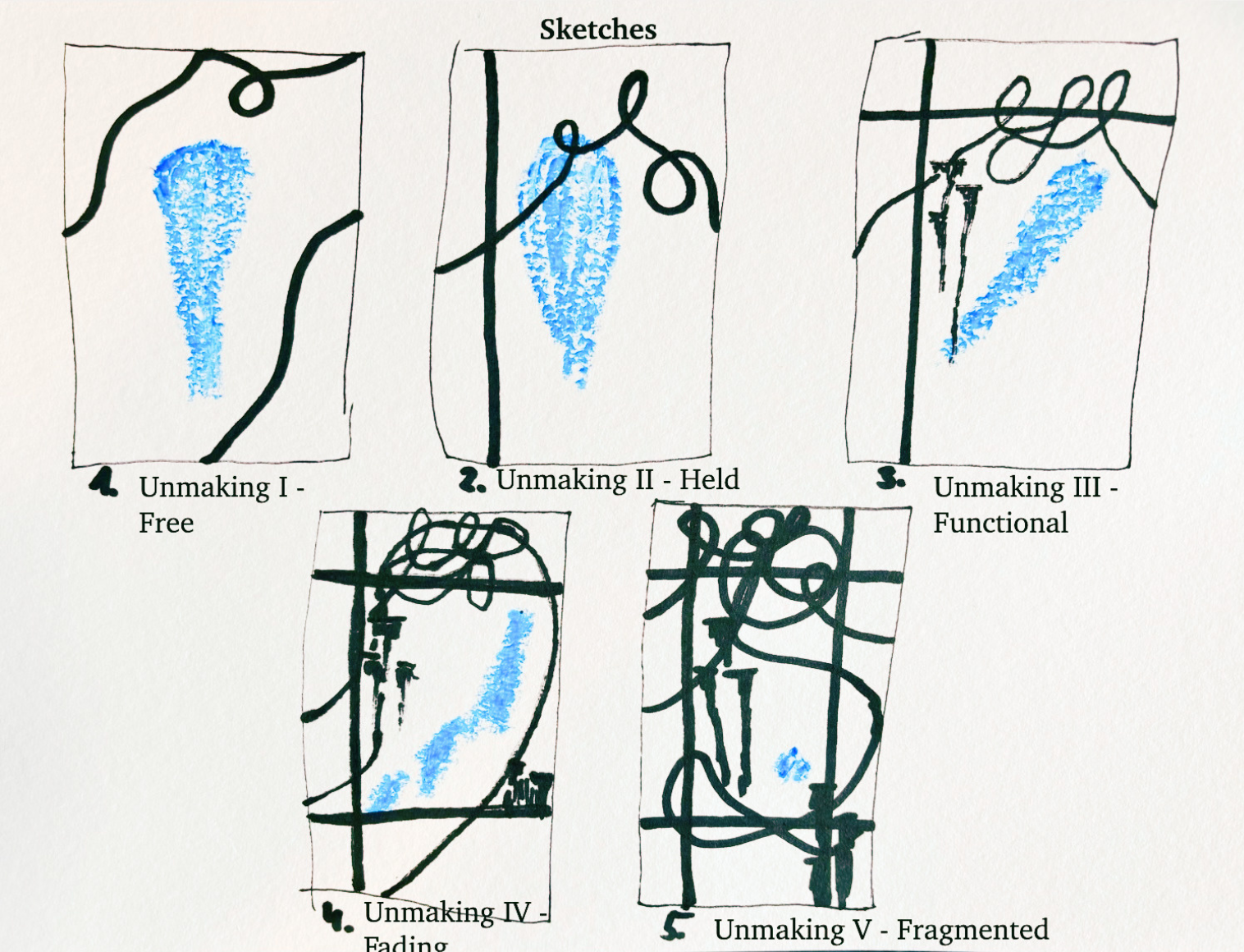
Sketches outlining the five stages of the Unmaking series
While working on these stages, I realized that the series was not only about a formal idea. It was connected to something I had experienced myself.
There was a time when I was confronted with many expectations at once. Some came from the outside, others from myself. I wanted to meet all of them. I tried to do everything right and kept adjusting to what was needed.
For a while, this works. You continue, you function, you keep going.
But slowly, something begins to shift. There is less space for yourself. Less clarity. Less connection to what actually matters to you. At some point, I noticed that I no longer really knew what was mine. What I wanted or what gave me a sense of joy.
Working on this series brought that feeling back in a quiet way. Not as a story, but as a state that became visible in the process of painting.
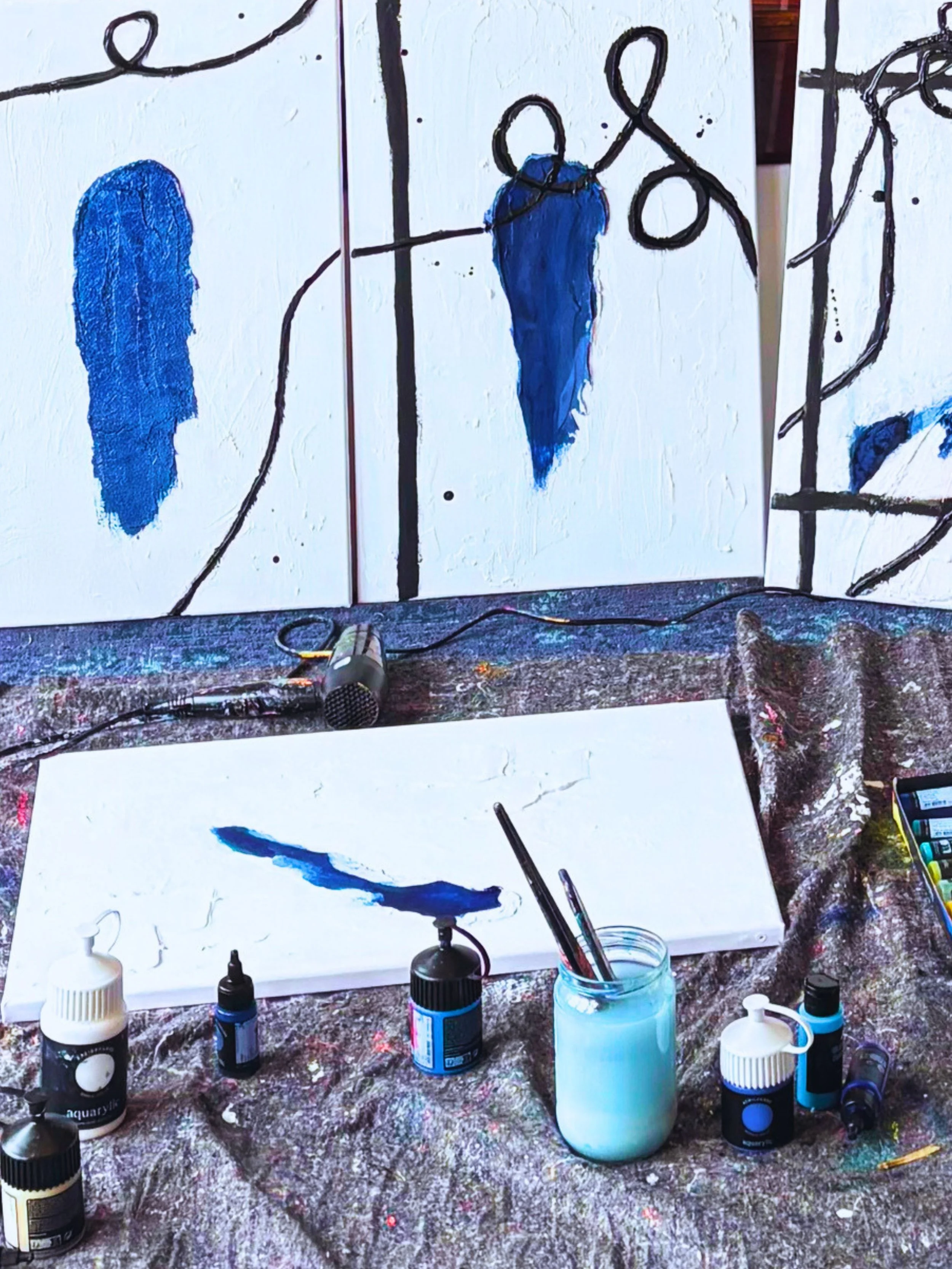
Studio process during the development of the Unmaking series
In the paintings, this shift happens gradually. The blue form, which holds the individual presence, does not disappear suddenly. It becomes less stable, less connected, and begins to fragment. At the same time, the black lines become more dominant. They no longer remain outside the figure but move through it and begin to define the space.
The white field also changes. It is no longer only an open space, but becomes increasingly structured and controlled.
What interested me was not a single moment of collapse, but this slow process of reduction. A movement from presence towards fragmentation.
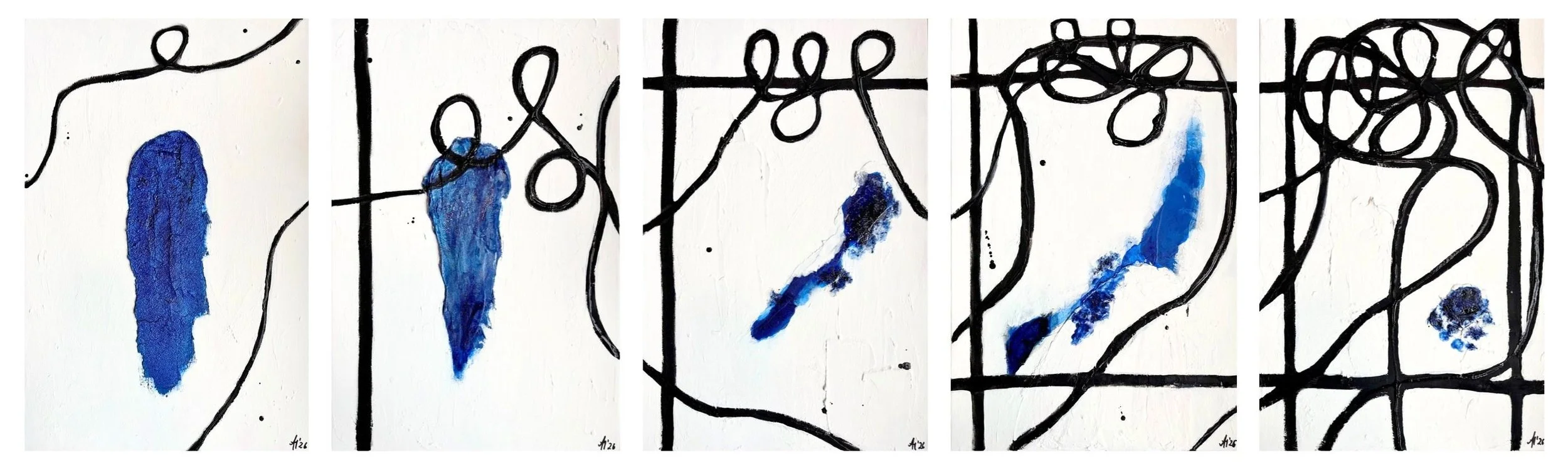
Unmaking, complete series
The final painting was the most difficult to resolve. I considered letting the blue disappear completely, which would have meant the complete loss of the individual.
In the end, I decided against that.
Instead, the form remains in fragments. It is no longer whole and no longer stable, but it is still there.
For me, this felt more honest. Because even in moments where you feel reduced or disconnected from yourself, something usually remains. Not fully accessible, not clearly defined.
This is where the series ends. Not with a resolution, but with a condition that remains open.