Pressure Marks
This series examines states of external pressure and inner overload through reduced visual language and strong contrast. It does not illustrate these conditions, but investigates how they become structurally visible, not as atmosphere, but as spatial and relational tension in the image.
The compositions are built around a restrained, light ground intersected by strong linear elements. These lines function as structural forces, suggesting social systems, expectations, and frameworks that both organize and constrain. They appear stabilizing and disruptive at once: ordering, yet unpredictable. Structure is treated here not as neutral order, but as an active and ambivalent influence that directly interacts with the emotional zones of the composition.
The orange zones act as concentrated fields within the image. They mark the emotional state of an individual under pressure: condensed, exposed, and active within structural constraint. They function as counter-presence rather than accent.
The works were created under physical strain and external pressure. This becomes visible in the interplay between controlled interventions and open, flowing passages, as well as in the visible reworking of the surfaces. Material decisions remain direct and process-led, allowing instability and revision to remain visible. Perception is therefore not secondary, but constitutive to the work’s meaning.
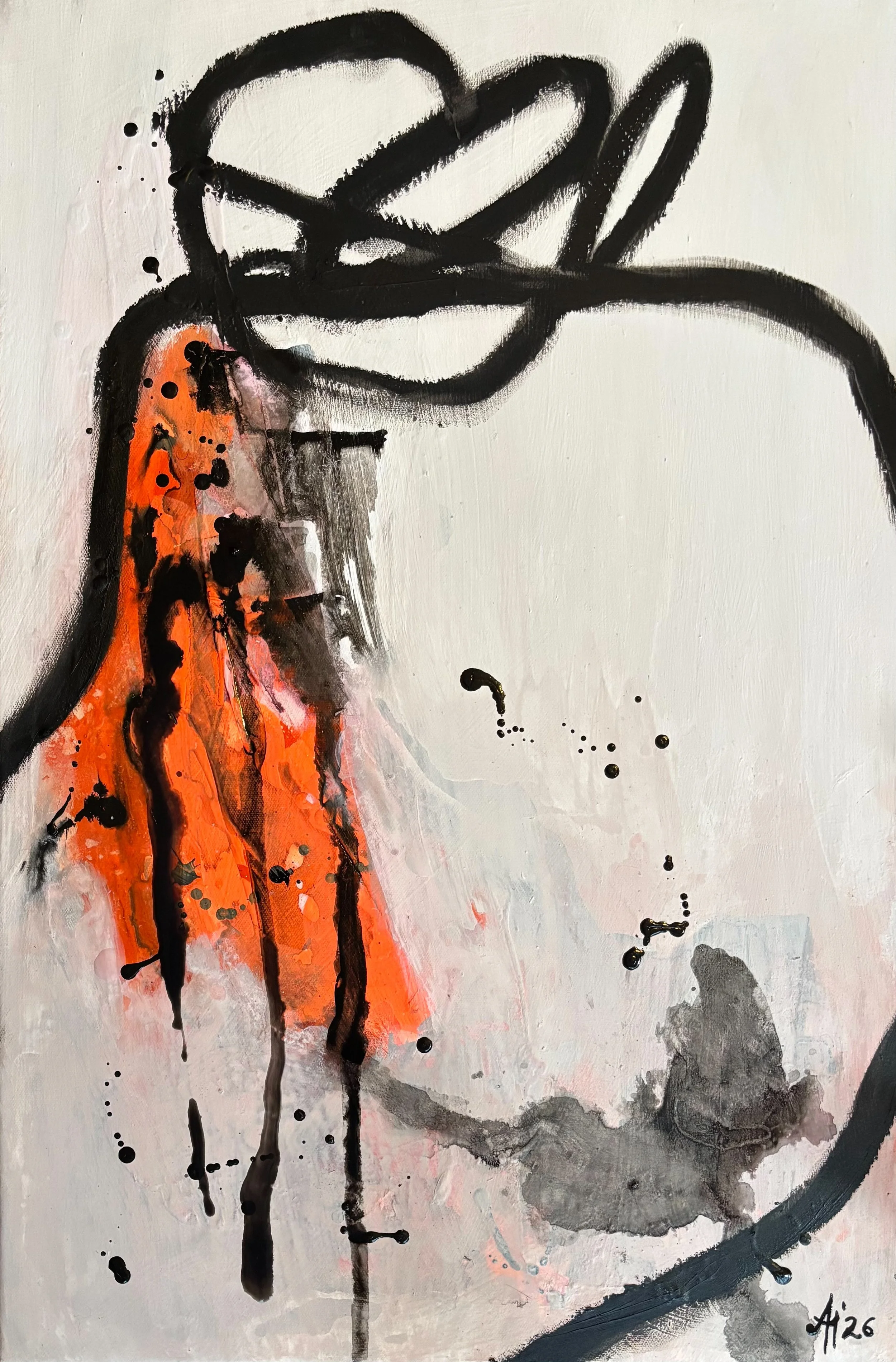
“Pressure Marks I - Entangled”, 40×60 cm, mixed media.
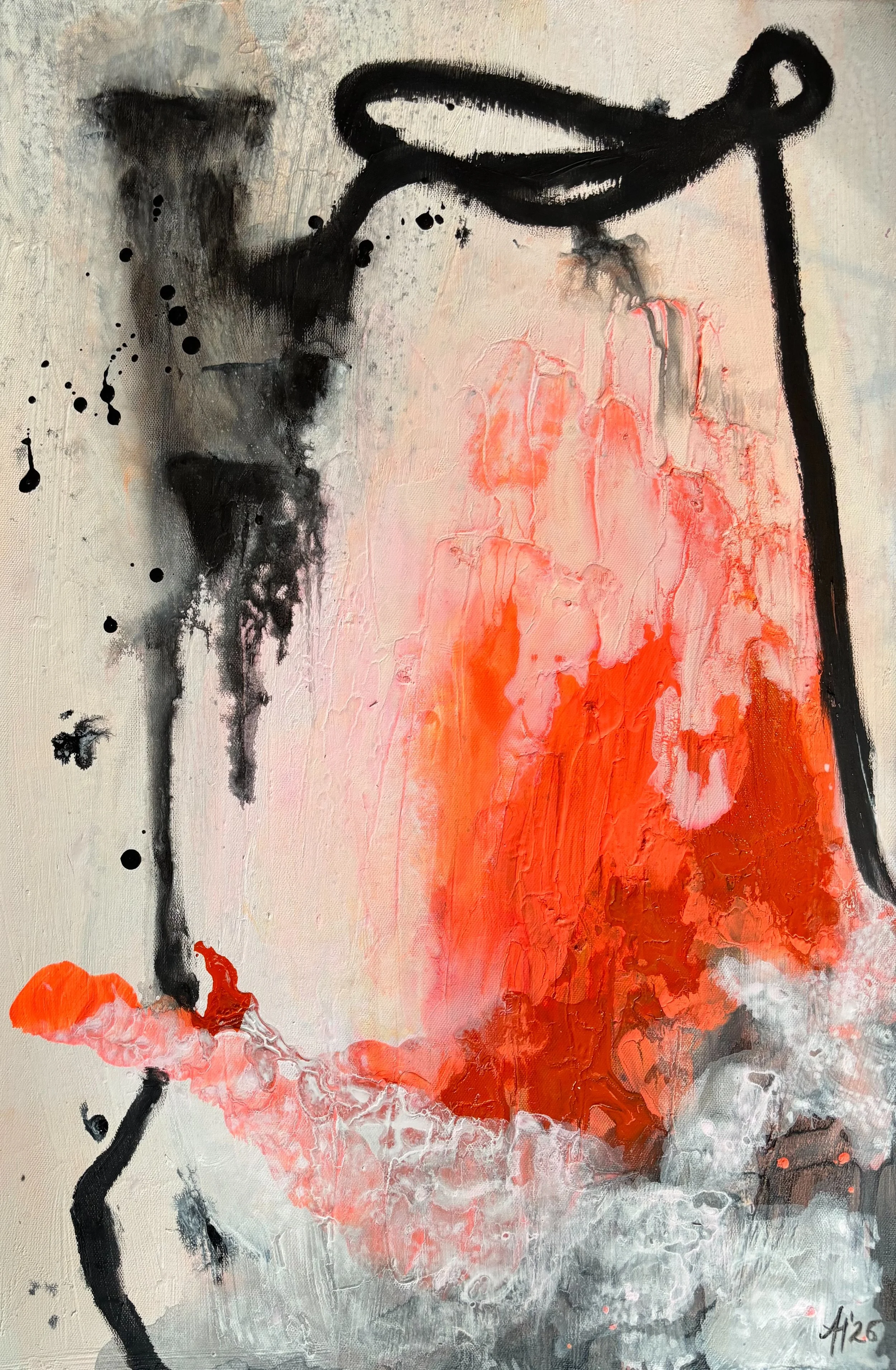
“Pressure Marks II - Exposed”, 40×60 cm, mixed media.
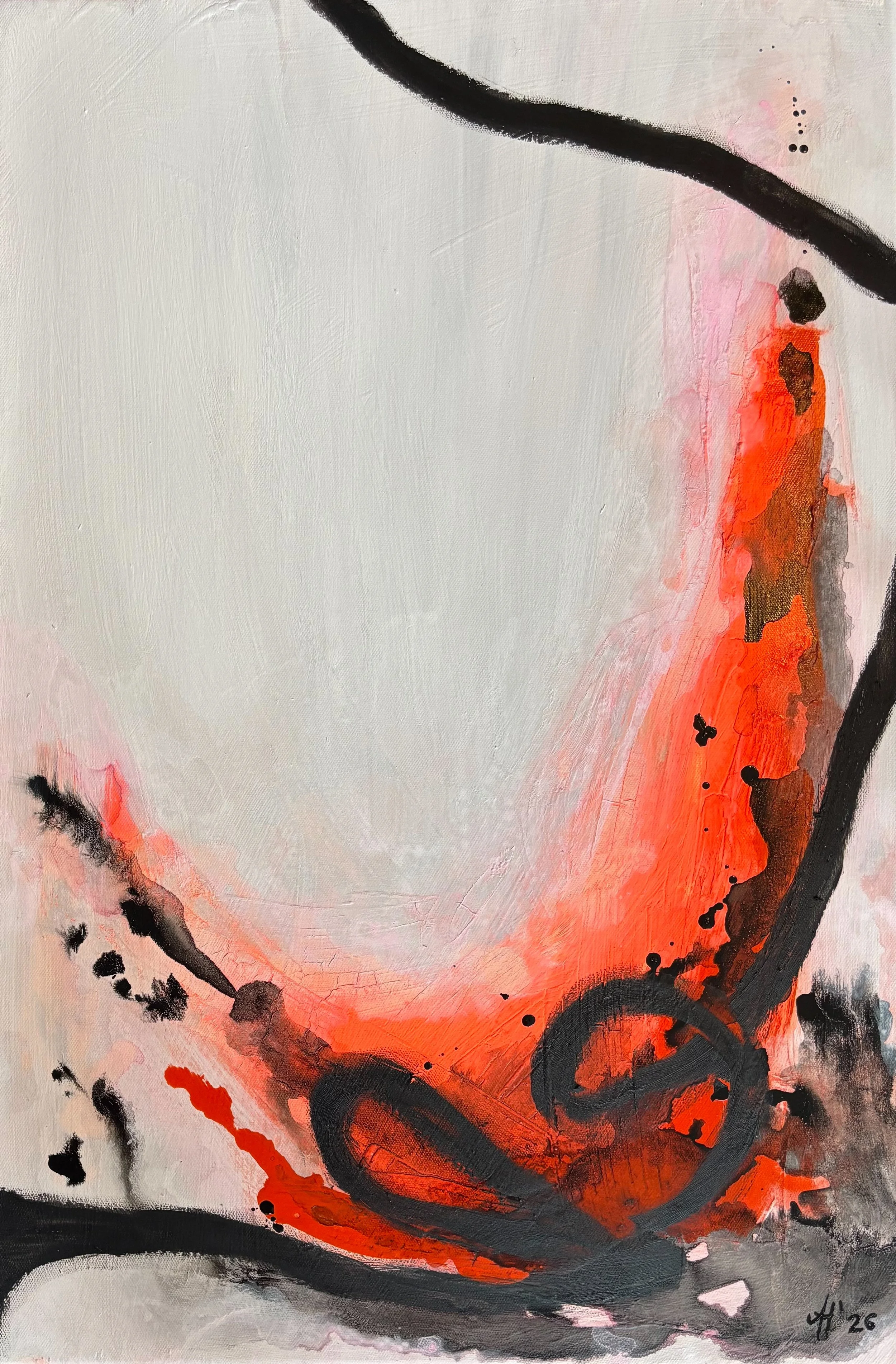
“Pressure Marks III - Redirected”, 40×60 cm, mixed media.
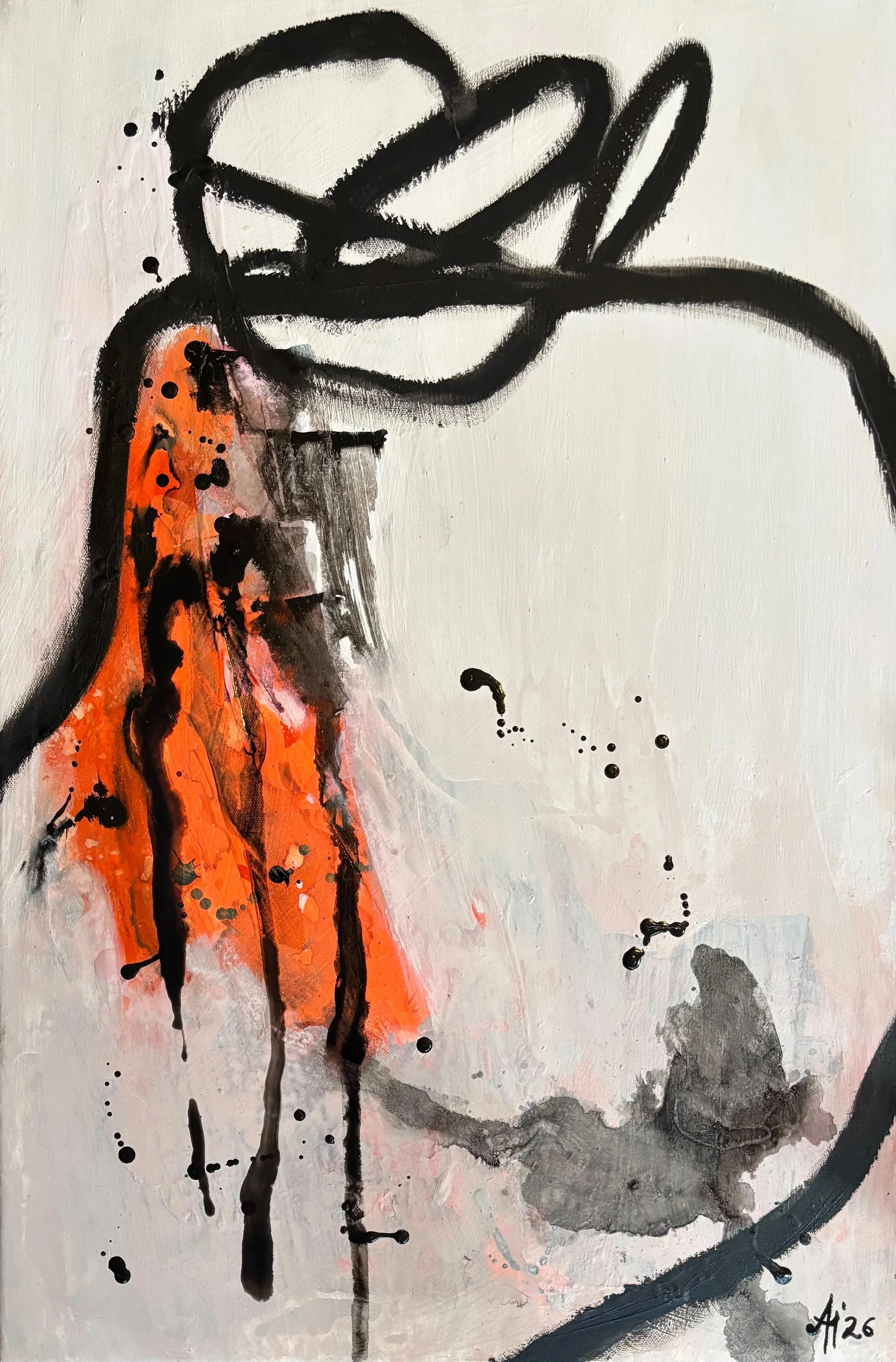
Pressure Marks I – Entangled
The work articulates a moment in which the individual becomes entangled within external structures of pressure and expectation. These structures are rendered through thick, gestural black lines that operate not merely as compositional elements, but as active forces within the image. Their presence is both imposing and directional, suggesting systems that organize while simultaneously constraining.
The overlay of these linear elements onto the central form marks a critical shift: what begins as external pressure transitions into internalized structure. The lines no longer remain outside the individual but begin to inscribe themselves into its visual and conceptual space, indicating the onset of internalization. This movement from exterior to interior is not depicted narratively, but structurally, through the physical layering of the painted surface.
The orange field functions as a concentrated emotional zone, representing the individual in a state of heightened intensity. Its luminosity can be read as a signal of alertness or alarm, emphasizing a condition of exposure rather than stability. In contrast to the defined and controlled quality of the black lines, the orange area appears more fluid and vulnerable, reinforcing the tension between imposed order and lived experience.
Rather than resolving this tension, the composition sustains a state of imbalance. The structural elements, while potentially capable of providing orientation, here exert pressure that destabilizes the central form. The work thus captures a transitional condition: a moment of overwhelm in which the individual has not yet reestablished autonomy or equilibrium, but is confronted with the necessity of doing so.
Pressure Marks II – Exposed
The work marks a shift from entanglement toward active confrontation. The individual is no longer fully contained within the surrounding structures but engages with them in a state of tension and partial release. The black linear elements, previously enclosing and dominant, begin to loosen and fragment, particularly in the upper left area where their structural clarity starts to dissolve.
This transformation is mirrored in the spatial dynamics of the composition. The central form expands beyond its earlier confinement while simultaneously receding in parts through veiling layers of white, suggesting both emergence and withdrawal. The individual is not presented as stable but as oscillating between visibility and concealment, negotiating its position within and against the imposed structures.
A critical moment occurs in the lower left where the orange field forcefully intersects and disrupts one of the black lines. This gesture reads as an act of rupture rather than resolution, a concentrated release of pressure that interrupts the structural order. Unlike in the previous work, the individual does not remain passively affected but begins to act upon the very forces that constrain it.
The orange zone, no longer uniform, is layered with darker tonalities, intensifying its visual and emotional charge. This modulation suggests an escalated state of alertness. It is not a singular signal but a complex, heightened condition in which pressure is actively processed rather than merely endured.
The composition does not resolve into equilibrium but sustains a dynamic instability. The individual is engaged in an ongoing negotiation with external expectations, no longer overwhelmed but not yet free. The work articulates a transitional phase of exposure in which confrontation, fragmentation, and transformation coexist.
Pressure Marks III – Redirected
The work marks a further transformation in the relationship between the individual and the surrounding structures of pressure and expectation. The black linear elements, once dominant and enclosing, have shifted downward. Their presence remains tangible, but no longer defines the entire spatial field. Instead, they occupy a lower zone where they come into direct contact with the central form without fully containing it.
This spatial reconfiguration opens a significant area above the orange field. Unlike in the previous works, the upper region remains unobstructed, allowing the central form to extend upward without immediate restriction. The individual is no longer primarily defined through confinement or rupture, but through the emergence of a newly negotiated space.
The interaction between the black lines and the orange zone suggests a process of internalization that has reached a different state. The structures are no longer experienced solely as external forces, nor are they resisted through direct opposition. Instead, they appear integrated into the visual logic of the composition. The black and orange elements begin to operate in continuity rather than contrast, forming a shared dynamic rather than a divided field.
This shift does not imply resolution in the sense of disappearance of pressure. The structural elements remain present and active, but their function has changed. They no longer impose themselves as purely constraining forces, but participate in shaping a condition in which tension can be sustained without immediate destabilization.
The work thus articulates a state in which confrontation has given way to negotiation. What emerges is neither submission nor complete autonomy, but a reconfigured coexistence. The individual and the structures appear as interdependent, having undergone a process through which a new balance becomes possible without eliminating the underlying tension.